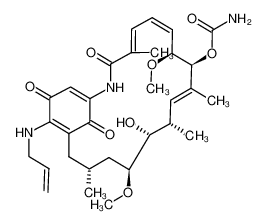
17-AAG also known as Tanespimycin is a benzoquinone ansamycin that has become a compound of interest in molecular chaperone research. It is known to inhibit Heat Shock Protein 90 (HSP90), a chaperone protein that plays a significant role in the folding, stability, and function of many client proteins, including those involved in signal transduction, cell cycle control, and survival. By binding to the ATP-binding domain of HSP90, 17-AAG disrupts its function, leading to the degradation of client proteins and the investigation of their cellular pathways. This property is particularly useful in the study of protein homeostasis and the cellular response to stress. In research environments, 17-AAG is employed to understand the mechanisms of action of HSP90 inhibitors and to explore the potential for targeting protein folding in various conditions. Furthermore, the compound is used to dissect the complex network of protein interactions that are critical for malignant transformation and to study the potential of HSP90 inhibitors in managing these processes. |