

www.ebiocell.com
| Host / Isotype | Clonality | Applications | MW (kDa) | Reactivity |
| Mouse IgG1 | Monoclonal | WB, IP, IHC-P, IF | N/A | Species independent |
| Applications Dilutions | |
| The application notes include recommended starting dilutions;optimal dilutions/concentrations should be detemined by the end user. | |
| WB=1:1000-5000 IP=1:50-200 IHC-P=1:100-500 IF=1:50-300 |
|
| Application Key | WB-Western Blot IP-Immunoprecipitation IHC-Immunohistochemistry IF-Immunofluorescence ICC-Immunocytochemistry FC-Flow Cytometry |
| Reactivity Key | H-Human M-Mouse R-Rat Mk-Monkey B-Bovine Pg-Pig Hm-Hamster Dg-Dog C-Chicken X-Xenopus Z-Zebrafish Hr-Horse All-All Species Expected |
| Product Information | |
| Conjugate | Unconjugate |
| Specificity | Acetyl-Lysine Mouse Monoclonal Antibody detects endogenous levels of Acetyl-Lysine protein. |
| Purification | Affinity purification |
| Concentration | 1mg/ml |
| Format | Liquid |
| Formulation | In PBS, pH 7.4, containing 0.02% sodium azide,0.5% BSA and 50% glycerol. |
| Shipping | Gel Pack |
| Storage | Store at -20°C least 1 year from the date of shipment. avoid repeated freeze/thaw cycles. Aliquots may be stored at +4°C for 1-2 weeks. |
| UniProt ID | N/A |
| Entrez Gene ID | N/A |
| Product Description | |
Acetylation of lysine, like phosphorylation of serine, threonine or tyrosine, is an important reversible modification controlling protein activity. The conserved amino-terminal domains of the four core histones (H2A, H2B, H3, and H4) contain lysines that are acetylated by histone acetyltransferases (HATs) and deacetylated by histone deacetylases (HDACs). Signaling resulting in acetylation/deacetylation of histones, transcription factors, and other proteins affects a diverse array of cellular processes including chromatin structure and gene activity, cell growth, differentiation, and apoptosis. Recent proteomic surveys suggest that acetylation of lysine residues may be a widespread and important form of posttranslational protein modification that affects thousands of proteins involved in control of cell cycle and metabolism, longevity, actin polymerization, and nuclear transport. The regulation of protein acetylation status is impaired in cancer and polyglutamine diseases, and HDACs have become promising targets for anti-cancer drugs currently in development. |
| Product Image Gallery | |
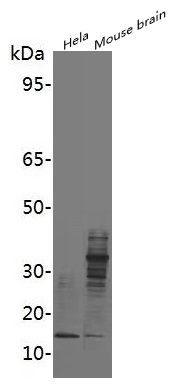 Western blot analysis of extracts on Hela, Mouse brain cells, using Acetyl-Lysine Mouse Monoclonal Antibody (EAB10171) at 1:2000 dilution. Secondary antibody Goat Anti-Mouse IgG (H&L)-HRP (EAB21001) at 1:5000 dilution.
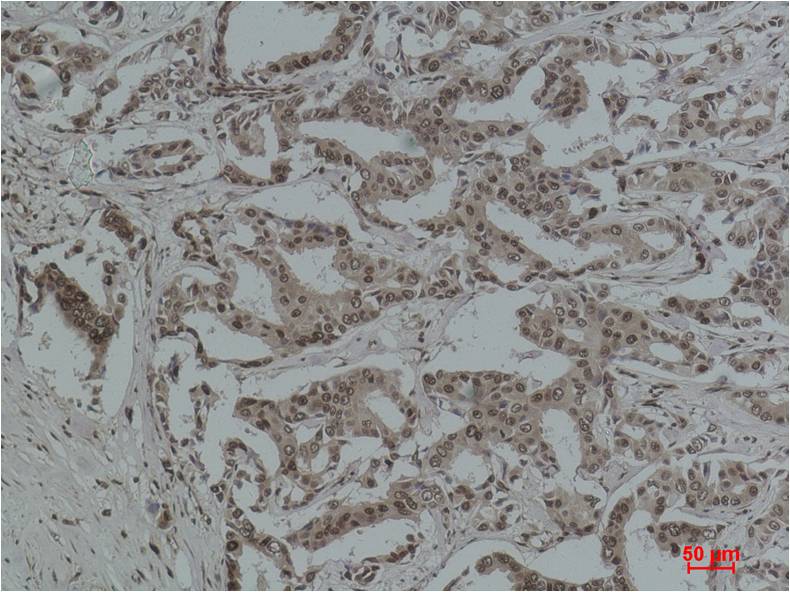 Immunohistochemical analysis of paraffin-embedded Human brest caricnoma tissue, using Acetyl-Lysine Mouse Monoclonal Antibody (EAB10171) at 1:500 dilution.
|
