
www.ebiocell.com
| Host / Isotype | Clonality | Applications | MW (kDa) | Reactivity |
| Rabbit IgG | Polyclonal | WB, ELISA | 36 | Human, Mouse, Rat |
| Applications Dilutions | |
| The application notes include recommended starting dilutions;optimal dilutions/concentrations should be detemined by the end user. | |
| WB=1:500-2000 |
|
| Application Key | WB-Western Blot IP-Immunoprecipitation IHC-Immunohistochemistry IF-Immunofluorescence ICC-Immunocytochemistry FC-Flow Cytometry |
| Reactivity Key | H-Human M-Mouse R-Rat Mk-Monkey B-Bovine Pg-Pig Hm-Hamster Dg-Dog C-Chicken X-Xenopus Z-Zebrafish Hr-Horse All-All Species Expected |
| Product Information | |
| Conjugate | Unconjugate |
| Specificity | Phospho-YB-1 (Ser102) Rabbit Polyclonal Antibody detects endogenous levels of YB1 protein only when phosphorylated on Ser102. |
| Purification | Affinity purification |
| Concentration | 1mg/ml |
| Format | Liquid |
| Formulation | In PBS, pH 7.4, containing 0.02% sodium azide,0.5% BSA and 50% glycerol. |
| Shipping | Gel Pack |
| Storage | Store at -20°C least 1 year from the date of shipment. avoid repeated freeze/thaw cycles. Aliquots may be stored at +4°C for 1-2 weeks. |
| UniProt ID | |
| Entrez Gene ID | |
| Product Description | |
YB1 also known as DNA-binding protein B, YBX1 belongs to a multifunctional protein family that plays a crucial role in regulating transcription and translation. YB1 can interact with diverse nucleic acid structures, functioning as both a transcription factor and an mRNA masking protein. A modular structure featuring a highly conserved N-terminal cold-shock domain and four basic C-terminal domains rich in arginine clusters and aromatic residues enables YB1′s binding capabilities. YB1 drives cell proliferation by activating growth-associated gene expression while repressing cell death-associated FAS gene expression, demonstrating a vital role in maintaining cellular homeostasis through regulation of cell survival and apoptosis pathways. |
| Product Image Gallery | |
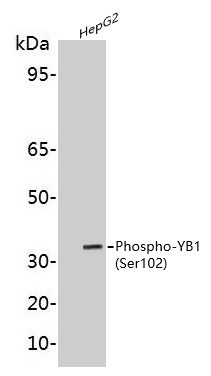 Western blot analysis of extracts on HepG2 cells treated with PMA, using Phospho-YB1 (Ser102) Rabbit Polyclonal Antibody (EAB10557) at 1:1000 dilution. The lane on the left is blocked with the phospho peptide.
|
