

www.ebiocell.com
| Host / Isotype | Clonality | Applications | MW (kDa) | Reactivity |
| Rabbit IgG | Polyclonal | WB, IHC-P, IF, ELISA | 39, 43 | Human, Mouse, Rat |
| Applications Dilutions | |
| The application notes include recommended starting dilutions;optimal dilutions/concentrations should be detemined by the end user. | |
| WB=1:500-2000 IHC-P=1:50-300 IF=1:50-300 |
|
| Application Key | WB-Western Blot IP-Immunoprecipitation IHC-Immunohistochemistry IF-Immunofluorescence ICC-Immunocytochemistry FC-Flow Cytometry |
| Reactivity Key | H-Human M-Mouse R-Rat Mk-Monkey B-Bovine Pg-Pig Hm-Hamster Dg-Dog C-Chicken X-Xenopus Z-Zebrafish Hr-Horse All-All Species Expected |
| Product Information | |
| Conjugate | Unconjugate |
| Specificity | Phospho-MKP1/MKP2 (Ser296/318) Rabbit Polyclonal Antibody detects endogenous levels of MKP1/MKP2 only when phosphorylated at Ser296/318. |
| Purification | Affinity purification |
| Concentration | 1mg/ml |
| Format | Liquid |
| Formulation | In PBS, pH 7.4, containing 0.02% sodium azide,0.5% BSA and 50% glycerol. |
| Shipping | Gel Pack |
| Storage | Store at -20°C least 1 year from the date of shipment. avoid repeated freeze/thaw cycles. Aliquots may be stored at +4°C for 1-2 weeks. |
| UniProt ID | |
| Entrez Gene ID | |
| Product Description | |
MKP1/MKP2 also known as DUSP1/DUSP4 belongs to the dual specificity protein phosphatase subfamily. These phosphatases inactivate their target kinases by dephosphorylating both the phosphoserine/threonine and phosphotyrosine residues. They negatively regulate members of the mitogen-activated protein (MAP) kinase superfamily (MAPK/ERK, SAPK/JNK, p38), which are associated with cellular proliferation and differentiation. Different members of the family of dual specificity phosphatases show distinct substrate specificities for various MAP kinases, different tissue distribution and subcellular localization, and different modes of inducibility of their expression by extracellular stimuli. This gene product inactivates ERK1, ERK2 and JNK, is expressed in a variety of tissues, and is localized in the nucleus. Two alternatively spliced transcript variants, encoding distinct isoforms, have been observed for this gene. |
| Product Image Gallery | |
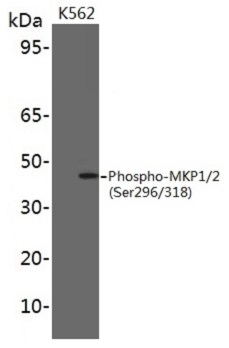 Western blot analysis of extracts on K562 cells treated with Heat shock, using Phospho-MKP1/MKP2 (Ser296/318) Rabbit Polyclonal Antibody (EAB10727) at 1:1000 dilution. The lane on the left is blocked with the phospho peptide.
Predicted band size: 39,43 kDa; Observed band size: 45 kDa |
