

www.ebiocell.com
| Host / Isotype | Clonality | Applications | MW (kDa) | Reactivity |
| Rabbit IgG | Polyclonal | WB, IHC-P, IF, ELISA | 56 | Human, Mouse |
| Applications Dilutions | |
| The application notes include recommended starting dilutions;optimal dilutions/concentrations should be detemined by the end user. | |
| WB=1:500-2000 IHC-P=1:50-300 IF=1:50-300 |
|
| Application Key | WB-Western Blot IP-Immunoprecipitation IHC-Immunohistochemistry IF-Immunofluorescence ICC-Immunocytochemistry FC-Flow Cytometry |
| Reactivity Key | H-Human M-Mouse R-Rat Mk-Monkey B-Bovine Pg-Pig Hm-Hamster Dg-Dog C-Chicken X-Xenopus Z-Zebrafish Hr-Horse All-All Species Expected |
| Product Information | |
| Conjugate | Unconjugate |
| Specificity | Phospho-MST1/MST2 (Thr183/180) Rabbit Polyclonal Antibody detects endogenous levels of MST1 and MST2 protein only when phosphorylated at Thr183 and Thr180. |
| Purification | Affinity purification |
| Concentration | 1mg/ml |
| Format | Liquid |
| Formulation | In PBS, pH 7.4, containing 0.02% sodium azide,0.5% BSA and 50% glycerol. |
| Shipping | Gel Pack |
| Storage | Store at -20°C least 1 year from the date of shipment. avoid repeated freeze/thaw cycles. Aliquots may be stored at +4°C for 1-2 weeks. |
| UniProt ID | |
| Entrez Gene ID | |
| Product Description | |
The mammalian Ste20-like kinases (MST) also known as KRS proteins are members of the GCK subfamily. MST are upstream regulators of mitogen-activated protein kinase (MAPK) signaling pathways that regulate multiple cellular processes, including proliferation, apoptosis, migration, and cytoskeletal rearrangement. This family of serine/threonine kinases includes MST1 (KRS2) and MST2 (KRS1), two functionally related proteins with conserved amino-terminal kinase domains and carboxy-terminal regulatory domains that contain nuclear export signals. During apoptosis, caspase-mediated cleavage of MST1/2 removes the inhibitory regulatory domain, triggering autophosphorylation and activation of the kinase domain, which is translocated to the nucleus. Nuclear translocation of the active kinase induces chromatin condensation and other events associated with apoptotic progression. |
| Product Image Gallery | |
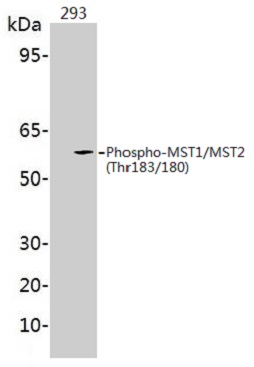 Western blot analysis of extracts on 293 cells treated with H2O2, using Phospho-MST1/MST2 (Thr183/180) Rabbit Polyclonal Antibody (EAB14421) at 1:1000 dilution. The lane on the left is blocked with the phospho peptide.
|
