
www.ebiocell.com
| Host / Isotype | Clonality | Applications | MW (kDa) | Reactivity |
| Rabbit IgG | Monoclonal | WB, IP, IHC-P, IF | 110 | Human |
| Applications Dilutions | |
| The application notes include recommended starting dilutions;optimal dilutions/concentrations should be detemined by the end user. | |
| WB=1:500-2000 IP=1:10-100 IHC-P=1:50-200 IF=1:50-200 |
|
| Application Key | WB-Western Blot IP-Immunoprecipitation IHC-Immunohistochemistry IF-Immunofluorescence ICC-Immunocytochemistry FC-Flow Cytometry |
| Reactivity Key | H-Human M-Mouse R-Rat Mk-Monkey B-Bovine Pg-Pig Hm-Hamster Dg-Dog C-Chicken X-Xenopus Z-Zebrafish Hr-Horse All-All Species Expected |
| Product Information | |
| Conjugate | Unconjugate |
| Specificity | Mer Rabbit Monoclonal Antibody detects endogenous levels of Mer protein. |
| Purification | Affinity purification |
| Concentration | 1mg/ml |
| Format | Liquid |
| Formulation | In PBS, pH 7.4, containing 0.02% sodium azide,0.5% BSA and 50% glycerol. |
| Shipping | Gel Pack |
| Storage | Store at -20°C least 1 year from the date of shipment. avoid repeated freeze/thaw cycles. Aliquots may be stored at +4°C for 1-2 weeks. |
| UniProt ID | |
| Entrez Gene ID | |
| Product Description | |
Receptor tyrosine kinases (RTKs) represent an important class of transmembrane signaling molecules. Binding of the extracellular domain of an RTK to its cognate ligand leads to receptor dimerization and the activation of the intrinsic tyrosine kinase activity of its intracellular kinase domain. The Axl/UFO subfamily of receptor tyrosine kinases is comprised of members Tyro3 (also referred to as BYK, Brt, Dtk, RSE, Tif or Sky), Axl (also called Tyro7 or UFO) and Mer (also called Nyk, c-Eyk and Tyro12). Members of this family have a common molecular structure which contains an N-terminal extracellular domain comprised of two Ig domains, two FNIII domains and a membrane spanning single helix followed by the cytoplasmic tyrosine kinase domain. These RTKs are functionally significant in spermatogenesis, immunoregulation and phagocytosis. Tyro3, Axl and Mer are widely expressed in adult tissues with their expression most abundant in brain, testis, lymphatic and vascular tissue. Tyro3 has been shown to undergo posttranslational modifications including both tyrosine phosphorylation as well as glycosylation. |
| Product Image Gallery | |
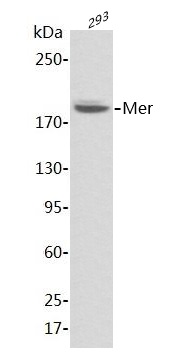 Western blot analysis of extracts on 293 cells, using Mer Rabbit Monoclonal Antibody (EAB21140) at 1:1000 dilution. Secondary antibody Goat Anti-Mouse IgG (H&L)-HRP (EAB21001) at 1:5000 dilution.
Predicted band size: 110 kDa; Observed band size: 188 kDa |
