

www.ebiocell.com
| Host / Isotype | Clonality | Applications | MW (kDa) | Reactivity |
| Rabbit IgG | Monoclonal | WB, IP, IHC-P, IF/ICC | 130 | Human, Mouse, Rat |
| Applications Dilutions | |
| The application notes include recommended starting dilutions;optimal dilutions/concentrations should be detemined by the end user. | |
| WB=1:1000-5000 IP=1:10-100 IHC-P=1:100-500 IF/ICC=1:100-500 |
|
| Application Key | WB-Western Blot IP-Immunoprecipitation IHC-Immunohistochemistry IF-Immunofluorescence ICC-Immunocytochemistry FC-Flow Cytometry |
| Reactivity Key | H-Human M-Mouse R-Rat Mk-Monkey B-Bovine Pg-Pig Hm-Hamster Dg-Dog C-Chicken X-Xenopus Z-Zebrafish Hr-Horse All-All Species Expected |
| Product Information | |
| Conjugate | Unconjugate |
| Specificity | pan-Cadherin Rabbit Monoclonal Antibody detects endogenous levels of E-, P-, N-, R-, VE-, and K-Cadherins. protein. |
| Purification | Affinity purification |
| Concentration | 1mg/ml |
| Format | Liquid |
| Formulation | In PBS, pH 7.4, containing 0.02% sodium azide,0.5% BSA and 50% glycerol. |
| Shipping | Gel Pack |
| Storage | Store at -20°C least 1 year from the date of shipment. avoid repeated freeze/thaw cycles. Aliquots may be stored at +4°C for 1-2 weeks. |
| UniProt ID | |
| Entrez Gene ID | |
| Product Description | |
pan-cadherin is essential for researchers studying cell-cell adhesion, tissue architecture, and morphogenesis, as cadherins are crucial calcium-dependent adhesion molecules that mediate homophilic binding between cells, thereby maintaining the structural integrity of tissues. The C-terminal cytoplasmic domains of cadherins interact with a variety of intracellular proteins, most notably β-catenin, α-catenin, and p120-catenin, which link cadherins to the actin cytoskeleton and are involved in the regulation of cell signaling pathways that control cell proliferation, differentiation, and migration. These interactions are vital for processes such as embryonic development, wound healing, and the maintenance of epithelial and endothelial barriers. Additionally, the disruption of cadherin-mediated adhesion is implicated in pathological conditions including cancer metastasis, where the loss of E-cadherin function can lead to increased cellular invasiveness and tumor progression. |
| Product Image Gallery | |
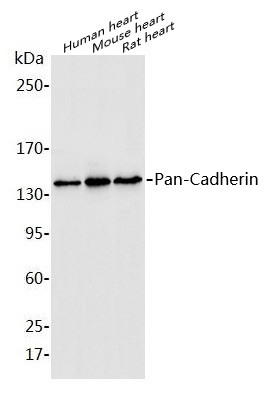 Western blot analysis of extracts on A431, C2C12, C6 cells, using pan-Cadherin Rabbit Monoclonal Antibody (EAB21266) at 1:1000 dilution. Secondary antibody Goat Anti-Rabbit IgG (H&L)-HRP (EAB21002) at 1:5000 dilution.
|
