

www.ebiocell.com
| Host / Isotype | Clonality | Applications | MW (kDa) | Reactivity |
| Rabbit IgG | Monoclonal | WB, IHC-P, IF/ICC | 72 | Human, Mouse, Rat |
| Applications Dilutions | |
| The application notes include recommended starting dilutions;optimal dilutions/concentrations should be detemined by the end user. | |
| WB=1:1000-5000 IHC-P=1:100-500 IF/ICC=1:100-500 |
|
| Application Key | WB-Western Blot IP-Immunoprecipitation IHC-Immunohistochemistry IF-Immunofluorescence ICC-Immunocytochemistry FC-Flow Cytometry |
| Reactivity Key | H-Human M-Mouse R-Rat Mk-Monkey B-Bovine Pg-Pig Hm-Hamster Dg-Dog C-Chicken X-Xenopus Z-Zebrafish Hr-Horse All-All Species Expected |
| Product Information | |
| Conjugate | Unconjugate |
| Specificity | MCAM/CD146 Rabbit Monoclonal Antibody detects endogenous levels of MCAM/CD146 protein. |
| Purification | Affinity purification |
| Concentration | 1mg/ml |
| Format | Liquid |
| Formulation | In PBS, pH 7.4, containing 0.02% sodium azide,0.5% BSA and 50% glycerol. |
| Shipping | Gel Pack |
| Storage | Store at -20°C least 1 year from the date of shipment. avoid repeated freeze/thaw cycles. Aliquots may be stored at +4°C for 1-2 weeks. |
| UniProt ID | |
| Entrez Gene ID | |
| Product Description | |
MCAM also known as Mel-CAM, MUC18, CD146 is a transmembrane glycoprotein. MCAM plays a critical role in cell adhesion, particularly in melanoma. MCAM′s structure includes a signal peptide, five immunoglobulin-like domains, a transmembrane region, and a short cytoplasmic tail, which are essential for function as a calcium-independent adhesion molecule. MCAM is predominantly expressed in advanced primary and metastatic melanomas, with expression levels correlating strongly with metastatic disease progression. Expression of MCAM occurs in 80% of advanced primary human melanomas, making MCAM a significant marker for tumorigenic activity. MCAM′s ability to initiate outside-in signaling pathways involving protein tyrosine kinases such as Fyn, FAK, and paxillin is crucial for influencing actin cytoskeleton dynamics, which affects cellular morphology and migration. MCAM is essential for maintaining thymic architecture and function, highlighting MCAM′s importance not only in cancer biology but also in immune system development. |
| Product Image Gallery | |
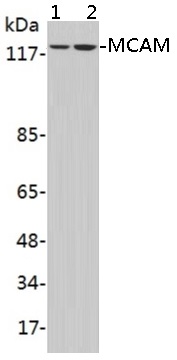 Western blot analysis of extracts on Hela, HepG2 cells, using MCAM/CD146 Rabbit Monoclonal Antibody (EAB21880) at 1:1000 dilution. Secondary antibody Goat Anti-Rabbit IgG (H&L)-HRP (EAB21002) at 1:5000 dilution.
Predicted band size: 72 kDa; Observed band size: 125 kDa |
