

www.ebiocell.com
| Host / Isotype | Clonality | Applications | MW (kDa) | Reactivity |
| Rabbit IgG | Polyclonal | WB, IHC-P, IF, ELISA | 50 | Human, Mouse, Rat |
| Applications Dilutions | |
| The application notes include recommended starting dilutions;optimal dilutions/concentrations should be detemined by the end user. | |
| WB=1:500-2000 IHC-P=1:50-300 IF=1:50-300 |
|
| Application Key | WB-Western Blot IP-Immunoprecipitation IHC-Immunohistochemistry IF-Immunofluorescence ICC-Immunocytochemistry FC-Flow Cytometry |
| Reactivity Key | H-Human M-Mouse R-Rat Mk-Monkey B-Bovine Pg-Pig Hm-Hamster Dg-Dog C-Chicken X-Xenopus Z-Zebrafish Hr-Horse All-All Species Expected |
| Product Information | |
| Conjugate | Unconjugate |
| Specificity | LXRα Rabbit Polyclonal Antibody detects endogenous levels of LXRα protein. |
| Purification | Affinity purification |
| Concentration | 1mg/ml |
| Format | Liquid |
| Formulation | In PBS, pH 7.4, containing 0.02% sodium azide,0.5% BSA and 50% glycerol. |
| Shipping | Gel Pack |
| Storage | Store at -20°C least 1 year from the date of shipment. avoid repeated freeze/thaw cycles. Aliquots may be stored at +4°C for 1-2 weeks. |
| UniProt ID | |
| Entrez Gene ID | |
| Product Description | |
LXRα(Liver X receptor alpha) also known as LXRA, NR1H3 is a member of the NR1 subfamily of the nuclear receptor superfamily. The NR1 family members are key regulators of macrophage function, controlling transcriptional programs involved in lipid homeostasis and inflammation. LXRα is highly expressed in visceral organs, including liver, kidney and intestine. It forms a heterodimer with retinoid X receptor (RXR), and regulates expression of target genes containing retinoid response elements. that heterodimerizes with RXR to regulate transcriptional programs controlling cholesterol efflux, bile acid metabolism, and de novo lipogenesis. LXRα integrates sterol sensing with innate immune signaling, modulating inflammatory gene expression and macrophage polarization through crosstalk with NF-κB and interferon-responsive pathways. Dysregulated LXRα signaling has been associated with cardiometabolic phenotypes, including atherosclerosis-relevant foam cell biology, fatty liver processes, and altered inflammatory responses. |
| Product Image Gallery | |
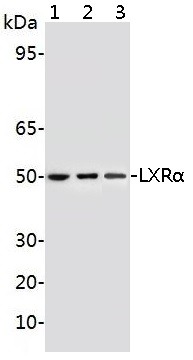 Western blot analysis of extracts on Hela, THP-1, HepG2 cells, using LXRα Rabbit Polyclonal Antibody (EAB11792) at 1:1000 dilution. Secondary antibody Goat Anti-Rabbit IgG (H&L)-HRP (EAB21002) at 1:5000 dilution.
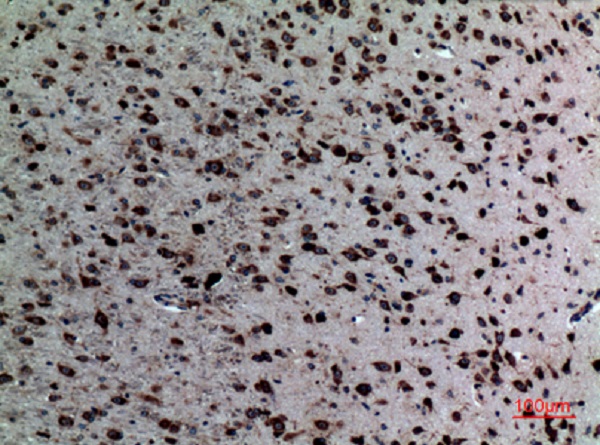 Immunohistochemical analysis of paraffin-embedded Mouse brain tissue, using LXRα Rabbit Polyclonal Antibody (EAB11792) at 1:100 dilution.
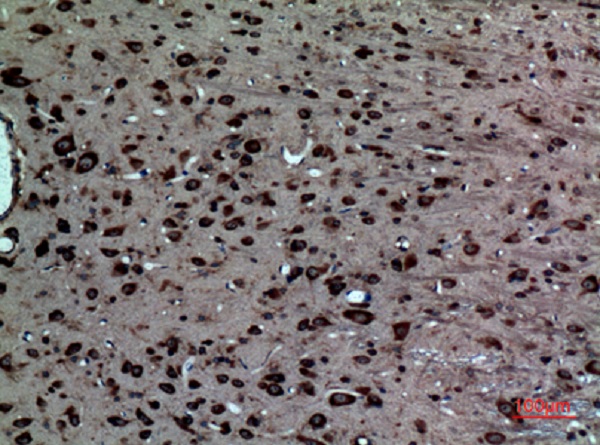 Immunohistochemical analysis of paraffin-embedded Rat brain tissue, using LXRα Rabbit Polyclonal Antibody (EAB11792) at 1:100 dilution.
|
