

| Host / Isotype | Clonality | Applications | MW (kDa) | Reactivity |
| Rabbit IgG | Polyclonal | WB, IHC-P, IF/ICC, ELISA | 20 | Human, Mouse |
| Application Key | WB-Western Blot IP-Immunoprecipitation IHC-Immunohistochemistry IF-Immunofluorescence ICC-Immunocytochemistry FC-Flow Cytometry |
| Reactivity Key | H-Human M-Mouse R-Rat Mk-Monkey B-Bovine Pg-Pig Hm-Hamster Dg-Dog C-Chicken X-Xenopus Z-Zebrafish Hr-Horse All-All Species Expected |
| Applications Dilutions | |
| The application notes include recommended starting dilutions;optimal dilutions/concentrations should be detemined by the end user. | |
| WB(Westem Blotting) IHC-P(Immunohistochemistry-Paraffin) IF/ICC(Immunofluorescence/Immunocytochemistry) ELISA(Enzyme-linked Immunosorbent Assay) |
WB=1:500-2000 IHC-P=1:50-300 IF/ICC=1:50-300 |
| Product Information | |
| Conjugate | Unconjugate |
| Specificity | FTL Rabbit Polyclonal Antibody detects endogenous levels of FTL protein. |
| Purification | Affinity purification |
| Concentration | 1mg/ml |
| Format | Liquid |
| Formulation | In PBS, pH 7.4, containing 0.02% sodium azide,0.5% BSA and 50% glycerol. |
| Shipping | Gel Pack |
| Storage | Store at -20°C least 1 year from the date of shipment. avoid repeated freeze/thaw cycles. Aliquots may be stored at +4°C for 1-2 weeks. |
| UniProt ID | |
| Entrez Gene ID | |
| Product Description | |
FTL also known as Ferritin light chain plays a crucial role in iron metabolism and cellular protection against oxidative stress, making FTL essential for maintaining cellular homeostasis. FTL is primarily located in the cytoplasm and is involved in the storage and release of iron, which is vital for various cellular processes, including DNA synthesis and cellular respiration. The ability of FTL to sequester excess iron helps prevent the formation of harmful free radicals, thereby protecting cells from oxidative damage. Additionally, alterations in FTL expression have been linked to pathological conditions such as hereditary hyperferritinemia cataract syndrome, where FTL overexpression contributes to cataract formation. |
| Product Image Gallery | |
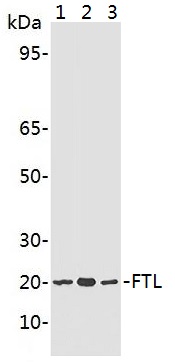 Western blot analysis of extracts on BT474, 293T, MCF7 cells, using FTL Rabbit Polyclonal Antibody (EAB13813) at 1:1000 dilution. Secondary antibody Goat Anti-Rabbit IgG (H&L)-HRP (EAB21002) at 1:5000 dilution.
|
