
| Host / Isotype | Clonality | Applications | MW (kDa) | Reactivity |
| Mouse IgG2a | Monoclonal | WB, IP, IHC-P, IF/ICC, FC, ELISA | 15 | Human, Mouse |
| Application Key | WB-Western Blot IP-Immunoprecipitation IHC-Immunohistochemistry IHC-P-Immunohistochemistry-Paraffin |
| Reactivity Key | H-Human M-Mouse R-Rat Mk-Monkey B-Bovine Pg-Pig Hm-Hamster Dg-Dog C-Chicken X-Xenopus Z-Zebrafish |
| Applications Dilutions | |
| The application notes include recommended starting dilutions;optimal dilutions/concentrations should be detemined by the end user. | |
| WB(Westem Blotting) IHC-P(Immunohistochemistry-Paraffin) IF/ICC(Immunofluorescence/Immunocytochemistry) ELISA(Enzyme-linked Immunosorbent Assay) |
WB=1:10000-50000 IP=1:100-500 IHC-P=1:200-1000 IF/ICC=1:100-500 FC=1:100-500 |
| Product Information | |
| Conjugate | Unconjugate |
| Specificity | IFITM1 Mouse Monoclonal antibody detects endogenous levels of ULK1 protein. |
| Purification | Affinity purification |
| Concentration | 1mg/ml |
| Format | Liquid |
| Formulation | In PBS, pH 7.4, containing 0.02% sodium azide,0.5% BSA and 50% glycerol. |
| Shipping | Gel Pack |
| Storage | Store at -20°C least 1 year from the date of shipment. avoid repeated freeze/thaw cycles. Aliquots may be stored at +4°C for 1-2 weeks. |
| UniProt ID | |
| Entrez Gene ID | |
| Product Description | |
IFITM1(Interferon induced transmembrane protein 1) is a small membrane-associated interferon-stimulated gene that modulates innate immune signaling and restricts the entry and replication of diverse enveloped viruses by altering membrane properties and endosomal trafficking. Its expression is induced downstream of type I/II interferon pathways through JAK–STAT signaling and contributes to cellular antiviral state programs and immune–epithelial interactions. IFITM1 also participates in processes linked to cell adhesion, proliferation, and stress responses, connecting interferon signaling to broader transcriptional and membrane remodeling networks. Dysregulated IFITM1 expression has been reported in inflammatory settings and multiple cancer contexts, making it a useful marker and functional node for studies of host–pathogen interactions and tumor-associated interferon responses. |
| Product Image Gallery | |
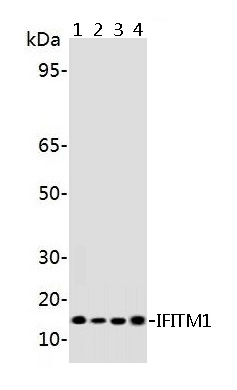 Western blot analysis of extracts on HL60, HepG2, K562 cells, using IFITM1 Mouse Monoclonal antibody (EAB22517) at 1:20000 dilution. Secondary antibody Goat Anti-Mouse IgG (H&L)-HRP (EAB21001) at 1:5000 dilution.
|
