
www.ebiocell.com
| Host / Isotype | Clonality | Applications | MW (kDa) | Reactivity |
| Rabbit IgG | Polyclonal | WB, ELISA | 35 | Human, Mouse, Rat |
| Applications Dilutions | |
| The application notes include recommended starting dilutions;optimal dilutions/concentrations should be detemined by the end user. | |
| WB=1:500-2000 | |
| Application Key | WB-Western Blot IP-Immunoprecipitation IHC-Immunohistochemistry IHC-P-Immunohistochemistry-Paraffin |
| Reactivity Key | H-Human M-Mouse R-Rat Mk-Monkey B-Bovine Pg-Pig Hm-Hamster Dg-Dog C-Chicken X-Xenopus Z-Zebrafish |
| Product Information | |
| Conjugate | Unconjugate |
| Specificity | RACK1 Rabbit Polyclonal Antibody detects endogenous levels of RACK1 protein. |
| Purification | Affinity purification |
| Concentration | 1mg/ml |
| Format | Liquid |
| Formulation | In PBS, pH 7.4, containing 0.02% sodium azide,0.5% BSA and 50% glycerol. |
| Shipping | Gel Pack |
| Storage | Store at -20°C least 1 year from the date of shipment. avoid repeated freeze/thaw cycles. Aliquots may be stored at +4°C for 1-2 weeks. |
| UniProt ID | |
| Entrez Gene ID | |
| Product Description | |
RACK1 also known as HLC-7, GNB2L1 is a 317 amino acid G protein b subunit-like protein that functions as a RACK and inhibits the activity of Src tyrosine kinases. In response to PKC activation, the intracellular localization of RACK1 and PKC bII changes, and RACK1 and PKC bII co-localize to the same sites. RACK1 is therefore thought to be a shuttling protein for PKC bII. A deficit in RACK1 may be associated with impaired PKC activation in the aging brain. The RACK1 gene is conserved in chimpanzee, dog, cow, mouse, rat, chicken, zebrafish, fruit fly, mosquito, C.elegans, S.pombe, S.cerevisiae, K.lactis, E.gossypii, M.grisea, N.crassa, A.thaliana, rice and P.falciparum, and maps to human chromosome 5q35.3. |
| Product Image Gallery | |
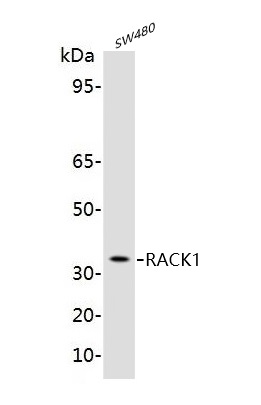 Western blot analysis of extracts on SW480 cells, using RACK1 Rabbit Polyclonal Antibody (EAB11077) at 1:1000 dilution. Secondary antibody Goat Anti-Rabbit IgG (H&L)-HRP (EAB21002) at 1:5000 dilution.
|
