
www.ebiocell.com
| Host / Isotype | Clonality | Applications | MW (kDa) | Reactivity |
| Rabbit IgG | Polyclonal | WB, ELISA | 69 | Human, Mouse, Rat |
| Applications Dilutions | |
| The application notes include recommended starting dilutions;optimal dilutions/concentrations should be detemined by the end user. | |
| WB=1:500-2000 | |
| Application Key | WB-Western Blot IP-Immunoprecipitation IHC-Immunohistochemistry IHC-P-Immunohistochemistry-Paraffin |
| Reactivity Key | H-Human M-Mouse R-Rat Mk-Monkey B-Bovine Pg-Pig Hm-Hamster Dg-Dog C-Chicken X-Xenopus Z-Zebrafish |
| Product Information | |
| Conjugate | Unconjugate |
| Specificity | MAG Rabbit Polyclonal Antibody detects endogenous levels of MAG protein. |
| Purification | Affinity purification |
| Concentration | 1mg/ml |
| Format | Liquid |
| Formulation | In PBS, pH 7.4, containing 0.02% sodium azide,0.5% BSA and 50% glycerol. |
| Shipping | Gel Pack |
| Storage | Store at -20°C least 1 year from the date of shipment. avoid repeated freeze/thaw cycles. Aliquots may be stored at +4°C for 1-2 weeks. |
| UniProt ID | |
| Entrez Gene ID | |
| Product Description | |
MAG(Myelin associated glycoprotein) is a type I membrane protein and member of the immunoglobulin superfamily. MAG plays a crucial role in the nervous system as a cell-surface adhesion protein that facilitates the connection between myelinating glial cells and neuronal axons. MAG is characterized by a sialic acid binding site and five immunoglobulin-like domains, classifying MAG within a specific subgroup of the immunoglobulin superfamily. This unique structure aids in the adhesion process and contributes to the inhibitory properties of myelin, which can impede axonal growth. Growth inhibition mediated by MAG can be counteracted when cerebellar neurons are pre-treated with neurotrophins such as brain-derived neurotrophic factor (BDNF) or glial cell line-derived neurotrophic factor (GDNF), suggesting these neurotrophins may enhance cellular signaling pathways, including the elevation of cyclic adenosine monophosphate (cAMP) and the activation of protein kinase A (PKA). |
| Product Image Gallery | |
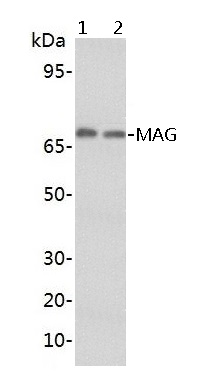 Western blot analysis of extracts on Hela, HepG2 cells, using MAG Rabbit Polyclonal Antibody (EAB11089) at 1:1000 dilution. Secondary antibody Goat Anti-Rabbit IgG (H&L)-HRP (EAB21002) at 1:5000 dilution.
|
