
www.ebiocell.com
| Host / Isotype | Clonality | Applications | MW (kDa) | Reactivity |
| Rabbit IgG | Polyclonal | WB, IHC-P, ELISA | 97, 110 | Human, Mouse, Rat |
| Applications Dilutions | |
| The application notes include recommended starting dilutions;optimal dilutions/concentrations should be detemined by the end user. | |
| WB=1:500-2000 IHC-P=1:50-300 |
|
| Application Key | WB-Western Blot IP-Immunoprecipitation IHC-Immunohistochemistry IHC-P-Immunohistochemistry-Paraffin |
| Reactivity Key | H-Human M-Mouse R-Rat Mk-Monkey B-Bovine Pg-Pig Hm-Hamster Dg-Dog C-Chicken X-Xenopus Z-Zebrafish |
| Product Information | |
| Conjugate | Unconjugate |
| Specificity | Phospho-Mer/Tyro3 (Tyr753/Tyr685) Rabbit Polyclonal Antibody detects endogenous levels of Mer/Tyro3 protein only when phosphorylated at Tyr753/Tyr685. |
| Purification | Affinity purification |
| Concentration | 1mg/ml |
| Format | Liquid |
| Formulation | In PBS, pH 7.4, containing 0.02% sodium azide,0.5% BSA and 50% glycerol. |
| Shipping | Gel Pack |
| Storage | Store at -20°C least 1 year from the date of shipment. avoid repeated freeze/thaw cycles. Aliquots may be stored at +4°C for 1-2 weeks. |
| UniProt ID | |
| Entrez Gene ID | |
| Product Description | |
Mer and Tyro3 are two members of the TAM family receptor tyrosine kinase that share a common NCAM (neural adhesion molecule)-related extracellular domain and a conserved intracellular tyrosine kinase domain. These receptors bind common homologous vitamin K dependent protein GAS6 and protein S to activate downstream signaling pathways. Members of this family have a common molecular structure which contains an N-terminal extracellular domain comprised of two Ig domains, two FNIII domains and a membrane spanning single helix followed by the cytoplasmic tyrosine kinase domain. These RTKs are functionally significant in spermatogenesis, immunoregulation and phagocytosis. Tyro3, Mer are widely expressed in adult tissues with their expression most abundant in brain, testis, lymphatic and vascular tissue. Tyro3 has been shown to undergo posttranslational modifications including both tyrosine phosphorylation as well as glycosylation. |
| Product Image Gallery | |
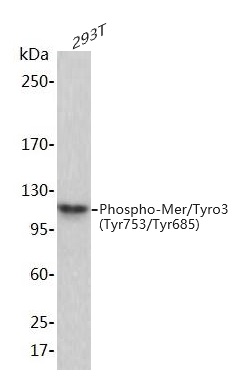 Western blot analysis of extracts on 293T cells, using Phospho-Mer/Tyro3 (Tyr753/Tyr685) Rabbit Polyclonal Antibody (EAB14443) at 1:1000 dilution. Secondary antibody Goat Anti-Rabbit IgG (H&L)-HRP (EAB21002) at 1:5000 dilution.
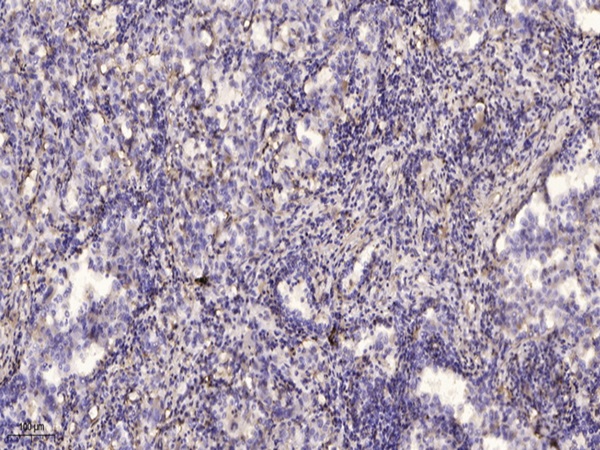 Immunohistochemical analysis of paraffin-embedded Human lung cancer tissue, using Phospho-Mer/Tyro3 (Tyr753/Tyr685) Rabbit Polyclonal Antibody (EAB14443) at 1:200 dilution.
|
