
| Host / Isotype | Clonality | Applications | MW (kDa) | Reactivity |
| Rabbit IgG | Polyclonal | WB, ELISA | 34 | Human, Mouse, Rat |
| Application Key | WB-Western Blot IP-Immunoprecipitation IHC-Immunohistochemistry IHC-P-Immunohistochemistry-Paraffin |
| Reactivity Key | H-Human M-Mouse R-Rat Mk-Monkey B-Bovine Pg-Pig Hm-Hamster Dg-Dog C-Chicken X-Xenopus Z-Zebrafish |
| Applications Dilutions | |
| The application notes include recommended starting dilutions;optimal dilutions/concentrations should be detemined by the end user. | |
| WB(Westem Blotting) IHC-P(Immunohistochemistry-Paraffin) IF/ICC(Immunofluorescence/Immunocytochemistry) ELISA(Enzyme-linked Immunosorbent Assay) |
WB=1:500-2000 |
| Product Information | |
| Conjugate | Unconjugate |
| Specificity | TCEA1 Rabbit Polyclonal Antibody detects endogenous levels of TCEA1 protein. |
| Purification | Affinity purification |
| Concentration | 1mg/ml |
| Format | Liquid |
| Formulation | In PBS, pH 7.4, containing 0.02% sodium azide,0.5% BSA and 50% glycerol. |
| Shipping | Gel Pack |
| Storage | Store at -20°C least 1 year from the date of shipment. avoid repeated freeze/thaw cycles. Aliquots may be stored at +4°C for 1-2 weeks. |
| UniProt ID | |
| Entrez Gene ID | |
| Product Description | |
TCEA1 also known as TFIIS, SII is an elongation factor that is essential for proper elongation past DNA arresting sites. TCEA1 plays a critical role in transcription by facilitating RNA synthesis elongation. TCEA1 is essential for overcoming transcriptional blocks at DNA arresting sites, which can impede RNA polymerase II (Pol II) progress. Through binding to Pol II, TCEA1 cleaves nascent RNA transcript, effectively releasing polymerase and allowing transcription to resume. This function maintains proper gene expression and cellular function, as disruptions in transcription elongation can lead to various cellular dysfunctions. TCEA1 is localized in the nucleus and features three independently-folding domains crucial for Pol II interaction. Mutations or defects in TCEA1 have been associated with salivary gland pleomorphic adenomas, the most prevalent type of benign epithelial tumors in salivary glands, highlighting TCEA1′s importance in both normal cellular processes and disease states. |
| Product Image Gallery | |
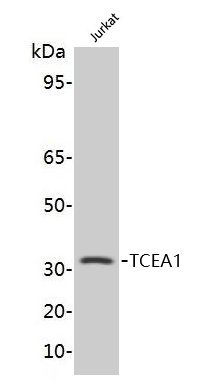 Western blot analysis of extracts on Jurkat cells, using TCEA1 Rabbit Polyclonal Antibody (EAB11235) at 1:1000 dilution. Secondary antibody Goat Anti-Rabbit IgG (H&L)-HRP (EAB21002) at 1:5000 dilution.
|
