

www.ebiocell.com
| Host / Isotype | Clonality | Applications | MW (kDa) | Reactivity |
| Rabbit IgG | Monoclonal | WB, IP, IHC-P, IF/ICC | 18 | Human, Rat |
| Applications Dilutions | |
| The application notes include recommended starting dilutions;optimal dilutions/concentrations should be detemined by the end user. | |
| WB=1:500-2000 IHC-P=1:50-200 IF/ICC=1:50-200 IP=1:10-100 |
|
| Application Key | WB-Western Blot IP-Immunoprecipitation IHC-Immunohistochemistry IHC-P-Immunohistochemistry-Paraffin |
| Reactivity Key | H-Human M-Mouse R-Rat Mk-Monkey B-Bovine Pg-Pig Hm-Hamster Dg-Dog C-Chicken X-Xenopus Z-Zebrafish |
| Product Information | |
| Conjugate | Unconjugate |
| Specificity | p21 Waf1/Cip1 Rabbit Monoclonal Antibody detects endogenous levels of p21 Waf1/Cip1 protein. |
| Purification | Affinity purification |
| Concentration | 1mg/ml |
| Format | Liquid |
| Formulation | In PBS, pH 7.4, containing 0.02% sodium azide,0.5% BSA and 50% glycerol. |
| Shipping | Gel Pack |
| Storage | Store at -20°C least 1 year from the date of shipment. avoid repeated freeze/thaw cycles. Aliquots may be stored at +4°C for 1-2 weeks. |
| UniProt ID | |
| Entrez Gene ID | |
| Product Description | |
p21 Waf1/Cip1 also known as CDKN1A is a potent cyclin-dependent kinase inhibitor. The encoded protein binds to and inhibits the activity of cyclin-cyclin-dependent kinase2 or -cyclin-dependent kinase4 complexes, and thus functions as a regulator of cell cycle progression at G1. The expression of this gene is tightly controlled by the tumor suppressor protein p53, through which this protein mediates the p53-dependent cell cycle G1 phase arrest in response to a variety of stress stimuli. This protein can interact with proliferating cell nuclear antigen, a DNA polymerase accessory factor, and plays a regulatory role in S phase DNA replication and DNA damage repair. This protein was reported to be specifically cleaved by CASP3-like caspases, which thus leads to a dramatic activation of cyclin-dependent kinase2, and may be instrumental in the execution of apoptosis following caspase activation. Mice that lack this gene have the ability to regenerate damaged or missing tissue. Multiple alternatively spliced variants have been found for this gene. |
| Product Image Gallery | |
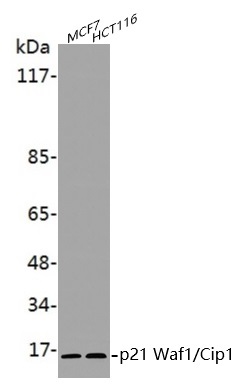 Western blot analysis of extracts on MCF7, HCT116 cells, using p21 Waf1/Cip1 Rabbit Monoclonal Antibody (EAB22346) at 1:1000 dilution. Secondary antibody Goat Anti-Rabbit IgG (H&L)-HRP (EAB21002) at 1:5000 dilution.
|
