

| Host / Isotype | Clonality | Applications | MW (kDa) | Reactivity |
| Rabbit IgG | Monoclonal | WB, IP, IHC-P, IF/ICC | 99 | Human, Mouse, Rat |
| Application Key | WB-Western Blot IP-Immunoprecipitation IHC-Immunohistochemistry IHC-P-Immunohistochemistry-Paraffin |
| Reactivity Key | H-Human M-Mouse R-Rat Mk-Monkey B-Bovine Pg-Pig Hm-Hamster Dg-Dog C-Chicken X-Xenopus Z-Zebrafish |
| Applications Dilutions | |
| The application notes include recommended starting dilutions;optimal dilutions/concentrations should be detemined by the end user. | |
| WB(Westem Blotting) IHC-P(Immunohistochemistry-Paraffin) IF/ICC(Immunofluorescence/Immunocytochemistry) ELISA(Enzyme-linked Immunosorbent Assay) |
WB=1:1000-5000 IP=1:10-100 IHC-P=1:100-500 IF/ICC=1:100-500 |
| Product Information | |
| Conjugate | Unconjugate |
| Specificity | Androgen Receptor/AR Rabbit Monoclonal Antibody detects endogenous levels of Androgen Receptor/AR protein. |
| Purification | Affinity purification |
| Concentration | 1mg/ml |
| Format | Liquid |
| Formulation | In PBS, pH 7.4, containing 0.02% sodium azide,0.5% BSA and 50% glycerol. |
| Shipping | Gel Pack |
| Storage | Store at -20°C least 1 year from the date of shipment. avoid repeated freeze/thaw cycles. Aliquots may be stored at +4°C for 1-2 weeks. |
| UniProt ID | |
| Entrez Gene ID | |
| Product Description | |
AR is more than 90 kb long and codes for a protein that has 3 major functional domains: the N-terminal domain, DNA-binding domain, and androgen-binding domain. AR plays a crucial role in mediating the effects of androgens, such as testosterone and dihydrotestosterone, which are vital for the development and maintenance of male reproductive physiology and phenotype. Located primarily in the cytoplasm and nucleus of target cells, AR undergoes a conformational change upon binding to ligands, allowing translocation to the nucleus where AR regulates gene expression. Nuclear localization is essential for function as a transcription factor, influencing biological processes, including cell growth, differentiation, and apoptosis. AR′s ability to rapidly degrade in the absence of ligand underscores the importance of androgen binding for stability and function, as binding leads to a significant increase in receptor stability that is specific to the type of androgen bound. |
| Product Image Gallery | |
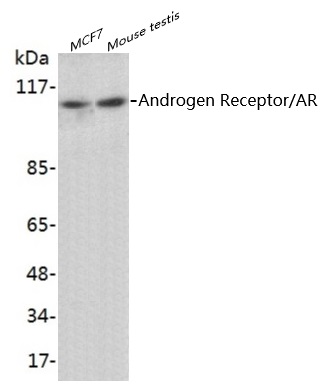 Western blot analysis of extracts on MCF7, Mouse testis cells, using Androgen Receptor/AR Rabbit Monoclonal Antibody (EAB21270) at 1:1000 dilution. Secondary antibody Goat Anti-Rabbit IgG (H&L)-HRP (EAB21002) at 1:5000 dilution.
Predicted band size: 99 kDa; Observed band size: 110 kDa |
