

| Host / Isotype | Clonality | Applications | MW (kDa) | Reactivity |
| Rabbit IgG | Polyclonal | WB, IP, ELISA | 11 | Human, Mouse, Rat |
| Application Key | WB-Western Blot IP-Immunoprecipitation IHC-Immunohistochemistry IHC-P-Immunohistochemistry-Paraffin |
| Reactivity Key | H-Human M-Mouse R-Rat Mk-Monkey B-Bovine Pg-Pig Hm-Hamster Dg-Dog C-Chicken X-Xenopus Z-Zebrafish |
| Applications Dilutions | |
| The application notes include recommended starting dilutions;optimal dilutions/concentrations should be detemined by the end user. | |
| WB(Westem Blotting) IHC-P(Immunohistochemistry-Paraffin) IF/ICC(Immunofluorescence/Immunocytochemistry) ELISA(Enzyme-linked Immunosorbent Assay) |
WB=1:500-2000 IP=1:20-200 |
| Product Information | |
| Conjugate | Unconjugate |
| Specificity | Cleaved-SUMO2/SUMO3 (Gly93) Rabbit Polyclonal Antibody detects endogenous levels of SUMO2/SUMO3 protein resulting from cleavage adjacent to Gly93. |
| Purification | Affinity purification |
| Concentration | 1mg/ml |
| Format | Liquid |
| Formulation | In PBS, pH 7.4, containing 0.02% sodium azide,0.5% BSA and 50% glycerol. |
| Shipping | Gel Pack |
| Storage | Store at -20°C least 1 year from the date of shipment. avoid repeated freeze/thaw cycles. Aliquots may be stored at +4°C for 1-2 weeks. |
| UniProt ID | |
| Entrez Gene ID | |
| Product Description | |
SUMO belong to the ubiquitin-like protein family and are characterized by their conserved beta-grasp fold structure, which is crucial for their ability to conjugate to target proteins through the sumoylation process. This structural integrity allows SUMO to interact effectively with E1, E2, and E3 enzymes, facilitating the attachment of SUMO to lysine residues on substrate proteins. The sumoylation mediated by SUMO plays a vital role in regulating various cellular functions, including nuclear transport, transcriptional regulation, apoptosis, and protein stability, thereby maintaining cellular homeostasis and responding to stress. The ability of SUMO to form poly-SUMO chains through their structural domains enhances their regulatory capacity, influencing processes such as DNA repair, cell cycle progression, and the modulation of transcription factors. |
| Product Image Gallery | |
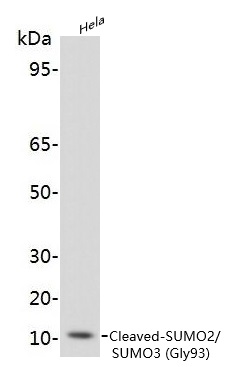 Western blot analysis of extracts on Hela cells, using Cleaved-SUMO2/SUMO3 (Gly93) Rabbit Polyclonal Antibody (EAB14017) at 1:1000 dilution. Secondary antibody Goat Anti-Rabbit IgG (H&L)-HRP (EAB21002) at 1:5000 dilution.
|
