| SKU-Pack Size | Availability | Size | Price | |
| EAB13563-30UL | In Stock | 30ul | $163.50 | |
| EAB13563-100UL | In Stock | 100ul | $343.50 | |
| EAB13563-200UL | In Stock | 200ul | $553.50 |
| Please select the country you are in to find your local distributor. |
| EbioCell | Phone:(540) 808-3925 | |
| Imperial Business Park 4819 Emperor Boulevard, | E-mail:order@ebiocell.com | |
| Canada | Suite 408 Durham, NC 27703, USA | Web:www.ebiocell.com |
| Product Information | |
| Applications | WB, IHC-P, IF |
| Species Reactivity | Human, Mouse, Rat |
| Host / Isotype | Rabbit IgG |
| Clonality | Polyclonal |
| Applications Dilutions | WB=1:500-2000 IHC-P=1:50-300 IF=1:50-300 |
| MW (kDa) | 49 |
| Conjugate | Unconjugate |
| Specificity | Phospho-PTP1B (Ser50) Rabbit Polyclonal Antibody detects endogenous levels of PTP1B protein only when phosphorylated at Ser50. |
| Purification | Affinity purification |
| Concentration | 1mg/ml |
| Format | Liquid |
| Formulation | In PBS, pH 7.4, containing 0.02% sodium azide,0.5% BSA and 50% glycerol. |
| Shipping | Gel Pack |
| Storage | Store at -20°C least 1 year from the date of shipment. avoid repeated freeze/thaw cycles. Aliquots may be stored at +4°C for 1-2 weeks. |
| Research Use | For Research Use Only. Not Intended for Diagnostic or Therapeutic Use. |
| Application Key WB-Western Blot IP-Immunoprecipitation IHC-Immunohistochemistry IF-Immunofluorescence ICC-Immunocytochemistry FC-Flow Cytometry |
|
| Reactivity Key H-Human M-Mouse R-Rat Mk-Monkey B-Bovine Pg-Pig Hm-Hamster Dg-Dog C-Chicken X-Xenopus Z-Zebrafish Hr-Horse All-All Species Expected |
|
| Product Bioinformatics | |
| Synonym(s) | PTP; PTP-1B; PTP-HA2; PTP1B; PTPN1; PTN1; RPTPrho; Tyrosine phosphatase 1b; Tyrosine-protein phosphatase non-receptor type 1 |
| Gene Aliases | PTPN1 |
| UniProt ID | |
| Entrez Gene ID | |
| Product Description | |
PTP1B (also designated PTPN1) is the founding member of the protein tyrosine phosphatase (PTP) family, which was isolated and identified based on its enzymatic activity and amino acid sequence. PTPs catalyze the hydrolysis of the phosphate monoesters specifically on tyrosine residues. Members of the PTP family share a highly conserved catalytic motif, which is essential for the catalytic activity. PTPs are known to be signaling molecules that regulate a variety of cellular processes including cell growth, differentiation, mitotic cycle, and oncogenic transformation. This PTP has been shown to act as a negative regulator of insulin signaling by dephosphorylating the phosphotryosine residues of insulin receptor kinase. This PTP was also reported to dephosphorylate epidermal growth factor receptor kinase, as well as JAK2 and TYK2 kinases, which implicated the role of this PTP in cell growth control, and cell response to interferon stimulation. Two transcript variants encoding different isoforms have been found for this gene. |
| Product Image Gallery | |
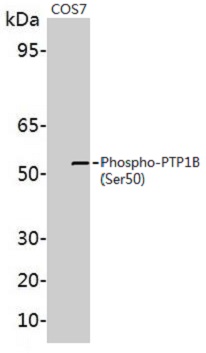
![]() Western blot analysis of extracts on COS7 cells treated with UV, using Phospho-PTP1B (Ser50) Rabbit Polyclonal Antibody (EAB13563) at 1:1000 dilution. The lane on the left is blocked with the phospho peptide.
|
| Specific Protocols | |