United States| SKU-Pack Size | Availability | Size | Price | |
| EAB14259-30UL | In Stock | 30ul | $133.50 | |
| EAB14259-100UL | In Stock | 100ul | $298.50 | |
| EAB14259-200UL | In Stock | 200ul | $508.50 |
| Please select the country you are in to find your local distributor. |
| EbioCell | Phone:(540) 808-3925 | |
| Imperial Business Park 4819 Emperor Boulevard, | E-mail:order@ebiocell.com | |
| United States | Suite 408 Durham, NC 27703, USA | Web:www.ebiocell.com |
| Product Information | |
| Applications | WB, ELISA |
| Species Reactivity | Human, Mouse, Rat |
| Host / Isotype | Rabbit IgG |
| Clonality | Polyclonal |
| Applications Dilutions | WB=1:500-2000 |
| MW (kDa) | 54 |
| Conjugate | Unconjugate |
| Specificity | MCT1 Rabbit Polyclonal Antibody detects endogenous levels of MCT1 protein. |
| Purification | Affinity purification |
| Concentration | 1mg/ml |
| Format | Liquid |
| Formulation | In PBS, pH 7.4, containing 0.02% sodium azide,0.5% BSA and 50% glycerol. |
| Shipping | Gel Pack |
| Storage | Store at -20°C least 1 year from the date of shipment. avoid repeated freeze/thaw cycles. Aliquots may be stored at +4°C for 1-2 weeks. |
| Research Use | For Research Use Only. Not Intended for Diagnostic or Therapeutic Use. |
| Application Key WB-Western Blot IP-Immunoprecipitation IHC-Immunohistochemistry IF-Immunofluorescence ICC-Immunocytochemistry FC-Flow Cytometry |
|
| Reactivity Key H-Human M-Mouse R-Rat Mk-Monkey B-Bovine Pg-Pig Hm-Hamster Dg-Dog C-Chicken X-Xenopus Z-Zebrafish Hr-Horse All-All Species Expected |
|
| Product Bioinformatics | |
| Synonym(s) | Solute Carrier Family 16 Member 1; MCT; HHF7; MCT1; MCT1D; SLC16A1 |
| Gene Aliases | SLC16A1 |
| UniProt ID | |
| Entrez Gene ID | |
| Product Description | |
MCT1 also known as SLC16A1 is a proton-linked monocarboxylate transporter that catalyzes the movement of many monocarboxylates, such as lactate and pyruvate, across the plasma membrane. MCT1 plays a crucial role in cellular metabolism by facilitating the transport of monocarboxylates such as lactate and pyruvate across the plasma membrane. This transport is vital for maintaining cellular energy homeostasis, particularly during anaerobic glycolysis, where lactic acid accumulates and can lead to a decrease in intracellular pH, ultimately inhibiting glycolysis if not efficiently exported. MCT1 is predominantly expressed in tumor cells and erythrocytes, making MCT1 a key player in cancer metabolism and a potential target for therapeutic interventions. |
| Product Image Gallery | |
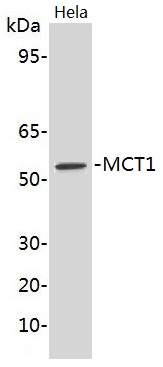
![]() Western blot analysis of extracts on Hela, Mouse lung cells, using MCT1 Rabbit Polyclonal Antibody (EAB14259) at 1:1000 dilution. Secondary antibody Goat Anti-Rabbit IgG (H&L)-HRP (EAB21002) at 1:5000 dilution.
|
| Specific Protocols | |