| SKU-Pack Size | Availability | Size | Price | |
| EAB11220-30UL | In Stock | 30ul | €115.70 | |
| EAB11220-100UL | In Stock | 100ul | €258.70 | |
| EAB11220-200UL | In Stock | 200ul | €440.70 |
| Please select the country you are in to find your local distributor. |
| Betaclonal | Phone£º+34 (0)91 471 6763 | |
| 29/1 Lomonosovsky Pr, | E-mail£ºtech@betaclonal.com | |
| Spain | Madrid, Spain | Web£ºwww.betaclonal.com |
| Product Information | |
| Applications | WB, IHC-P, ELISA |
| Species Reactivity | Human, Mouse, Rat |
| Host / Isotype | Rabbit IgG |
| Clonality | Polyclonal |
| Applications Dilutions | WB=1:500-2000¡¡ IHC-P=1:50-300 |
| MW (kDa) | 31 |
| Conjugate | Unconjugate |
| Specificity | TMEM192 Rabbit Polyclonal Antibody detects endogenous levels of TMEM192 protein. |
| Purification | Affinity purification |
| Concentration | 1mg/ml |
| Format | Liquid |
| Formulation | In PBS, pH 7.4, containing 0.02% sodium azide,0.5% BSA and 50% glycerol. |
| Shipping | Gel Pack |
| Storage | Store at -20¡ãC least 1 year from the date of shipment. avoid repeated freeze/thaw cycles. Aliquots may be stored at +4¡ãC for 1-2 weeks. |
| Research Use | For Research Use Only. Not Intended for Diagnostic or Therapeutic Use. |
| Application Key WB-Western Blot IP-Immunoprecipitation IHC-Immunohistochemistry IHC-P-Immunohistochemistry-Paraffin |
|
| Reactivity Key H-Human M-Mouse R-Rat Mk-Monkey B-Bovine Pg-Pig Hm-Hamster Dg-Dog C-Chicken X-Xenopus Z-Zebrafish |
|
| Product Bioinformatics | |
| Synonym(s) | Transmembrane protein 192; TMEM192 |
| Gene Aliases | TMEM192 |
| UniProt ID | |
| Entrez Gene ID | |
| Product Description | |
TMEM192 is a 271 amino acid protein encoded by a gene located on human chromosome 4, which harbors nearly 900 genes and represents about 6% of the human genome. TMEM192 is primarily localized in the endoplasmic reticulum, where TMEM192 plays a crucial role in cellular processes such as protein folding and quality control. This localization is significant because the endoplasmic reticulum is essential for the synthesis and maturation of secretory and membrane proteins, and any dysfunction in this organelle can lead to various diseases, including neurodegenerative disorders. Additionally, chromosome 4 contains genes associated with several genetic conditions, such as Huntington′s disease and achondroplasia, highlighting the importance of studying TMEM192 in understanding cellular mechanisms and potential therapeutic targets. |
| Product Image Gallery | |
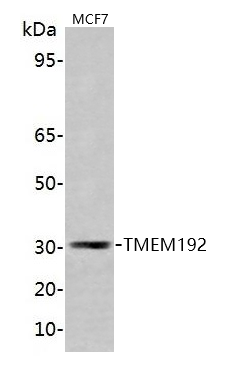
![]() Western blot analysis of extracts on MCF7 cells, using TMEM192 Rabbit Polyclonal Antibody (EAB11220) at 1:1000 dilution. Secondary antibody Goat Anti-Rabbit IgG (H&L)-HRP (EAB21002) at 1:5000 dilution.
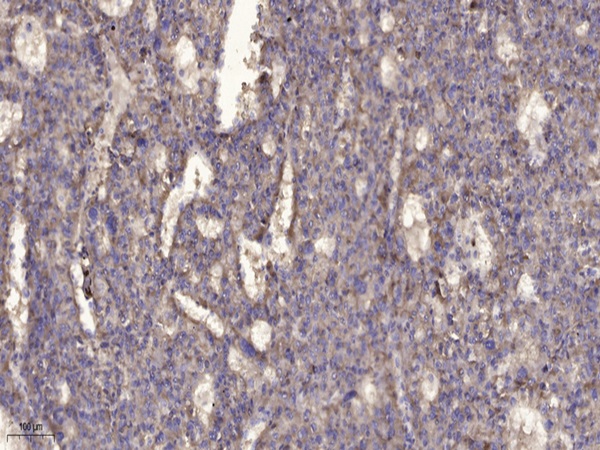
![]() Immunohistochemical analysis of paraffin-embedded Human liver cancer tissue, using TMEM192 Rabbit Polyclonal Antibody (EAB11220) at 1:200 dilution.
|
| Specific Protocols | |