United States| SKU-Pack Size | Availability | Size | Price | |
| EAB23005-100UL | In Stock | 100ul | $298.50 |
| Please select the country you are in to find your local distributor. |
| EbioCell | Phone:(540) 808-3925 | |
| Imperial Business Park 4819 Emperor Boulevard, | E-mail:order@ebiocell.com | |
| United States | Suite 408 Durham, NC 27703, USA | Web:www.ebiocell.com |
| Product Information | |
| Applications | IHC-P, IF/ICC, FC, ELISA |
| Species Reactivity | Human |
| Host / Isotype | Mouse IgG1 |
| Clonality | Monoclonal |
| Applications Dilutions | IHC-P=1:100-500 IF/ICC=1:100-500 FC=1:50-200 |
| MW (kDa) | 132 |
| Conjugate | Unconjugate |
| Specificity | G9a/EHMT2 Mouse Monoclonal Antibody detects endogenous levels of G9a/EHMT2 protein. |
| Purification | Affinity purification |
| Concentration | 1mg/ml |
| Format | Liquid |
| Formulation | In PBS, pH 7.4, containing 0.02% sodium azide,0.5% BSA and 50% glycerol. |
| Shipping | Gel Pack |
| Storage | Store at -20°C least 1 year from the date of shipment. avoid repeated freeze/thaw cycles. Aliquots may be stored at +4°C for 1-2 weeks. |
| Research Use | For Research Use Only. Not Intended for Diagnostic or Therapeutic Use. |
| Application Key WB-Western Blot IP-Immunoprecipitation IHC-Immunohistochemistry IHC-P-Immunohistochemistry-Paraffin |
|
| Reactivity Key H-Human M-Mouse R-Rat Mk-Monkey B-Bovine Pg-Pig Hm-Hamster Dg-Dog C-Chicken X-Xenopus Z-Zebrafish |
|
| Product Bioinformatics | |
| Synonym(s) | Euchromatic histone lysine methyltransferase 2; G9A; BAT8; GAT8; NG36; KMT1C; C6orf30; EHMT2 |
| Gene Aliases | EHMT2 |
| UniProt ID | |
| Entrez Gene ID | |
| Product Description | |
G9a also known as NG36, EHMT2 is a methyltransferase that methylates lysine residues of histone H3. G9a plays a crucial role in the regulation of gene expression through its function as a histone methyltransferase, specifically targeting histone H3 lysine 9 for methylation. This post-translational modification is vital for the repression of developmental genes and is essential for early embryogenesis, highlighting G9a′s importance in cellular differentiation and development. G9a′s ability to add methyl groups to lysine residues not only influences transcriptional regulation but also contributes to the organization of chromatin structure, thereby impacting overall genomic stability. |
| Product Image Gallery | |
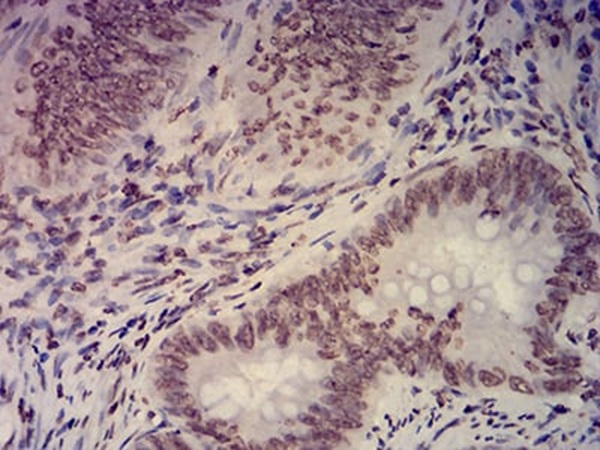
![]() Immunohistochemical analysis of paraffin-embedded Human rectum cancer tissue, using G9a/EHMT2 Mouse Monoclonal Antibody (EAB23005) at 1:200 dilution.
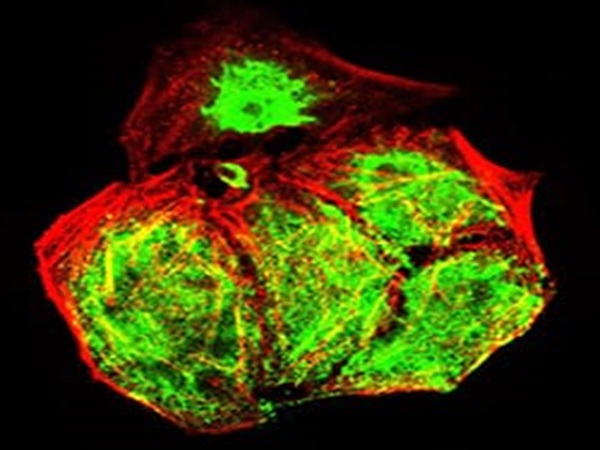
![]() Immunofluorescence analysis of Hela cell, using G9a/EHMT2 Mouse Monoclonal Antibody (EAB23005) at 1:200 dilution.
|
| Specific Protocols | |