USA£º(540) 808-3925
China£º400-117-0038
Germany
Shopping Cart
Sign in \ Register

ACSL1 Rabbit Monoclonal Antibody
Catalog #£ºEAB21172
  SKU-Pack Size Availability Size Price
EAB21172-100UL In Stock 100ul €336.70
If you want to get a larger packsize, Please contact your local distributor or
email us at info@ebiocell.com
Please select the country you are in to find your local distributor.
Dianost Phone£º+49 (0) 40 65472-053
Bullenkoppel 11£¬ 23896 Poggensee, E-mail£ºola@olasciences.com
Germany Germany Web£ºwww.olasciences.com
Product Information
Applications WB, IHC-P, IF/ICC
Species Reactivity Human
Host / Isotype Rabbit IgG
Clonality Monoclonal
Applications Dilutions WB=1:1000-5000¡¡
IHC-P=1:100-500¡¡
IF/ICC=1:100-500
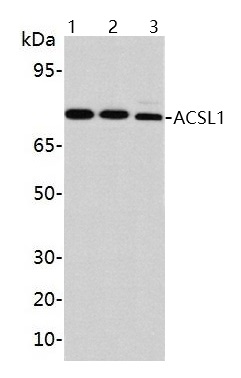
MW (kDa) 78
Conjugate Unconjugate
Specificity ACSL1 Rabbit Monoclonal Antibody detects endogenous levels of ACSL1 protein.
Purification Affinity purification
Concentration 1mg/ml
Format Liquid
Formulation In PBS, pH 7.4, containing 0.02% sodium azide,0.5% BSA and 50% glycerol.
Shipping Gel Pack
Storage Store at -20¡ãC least 1 year from the date of shipment. avoid repeated freeze/thaw cycles. Aliquots may be stored at +4¡ãC for 1-2 weeks.
Research Use For Research Use Only. Not Intended for Diagnostic or Therapeutic Use.
Application Key

WB-Western Blot IP-Immunoprecipitation IHC-Immunohistochemistry IHC-P-Immunohistochemistry-Paraffin
IF
-Immunofluorescence ICC-Immunocytochemistry FC-Flow Cytometry

Reactivity Key

H-Human M-Mouse R-Rat Mk-Monkey B-Bovine Pg-Pig Hm-Hamster Dg-Dog C-Chicken X-Xenopus Z-Zebrafish
Hr
-Horse All-All Species Expected

Product Bioinformatics
Synonym(s) Acyl-CoA synthetase long chain family member 1; ACS1; LACS; FACL1; FACL2; LACS1; LACS2; ACSL1
Gene Aliases ACSL1
UniProt ID

P33121

Entrez Gene ID

2180

Product Description

ACSL1(Acyl-CoA synthetase long chain family member 1) is an isozyme of the long-chain fatty-acid-coenzyme A ligase family. ACSL1 plays a crucial role in lipid metabolism, specifically in the activation of long-chain fatty acids to acyl-CoA derivatives, which are essential for various metabolic pathways, including the synthesis of cellular lipids and the β-oxidation process. This activation allows fatty acids to be utilized for energy production and the formation of important biomolecules such as triacylglycerols, phospholipids, and cholesteryl esters. ACSL1 is predominantly expressed in the liver and exhibits a preference for substrates like palmitoleate, oleate, and linoleate, highlighting its significance in maintaining lipid homeostasis and energy balance within the body. ACSL1′s ability to interact with various long-chain fatty acids underscores its importance in metabolic regulation and potential implications in metabolic disorders.

Product Image Gallery
Specific Protocols
>> Western Blotting Protocol >> Immunoprecipitation Protocol
>> Immunohistochemistry Protocol >> Immunofluorescence Protocol
>> Immunocytochemistry Protocol >> Flow Cytometry Protocol
>> ChIP Protocol >> ELISA Protocol
>> HPLC Protocol >> PCR Protocol
For Research Use Only, Not For Diagnostic Or Therapeutic Procedures.
Copyright 2015 EbioCell, Inc. All Rights Reserved. ¡¡±¸°¸ºÅ£º¾©ICP±¸2025156413ºÅ-1